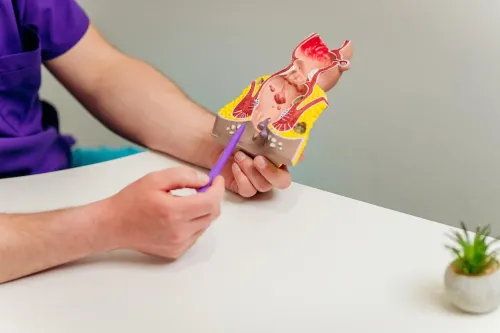
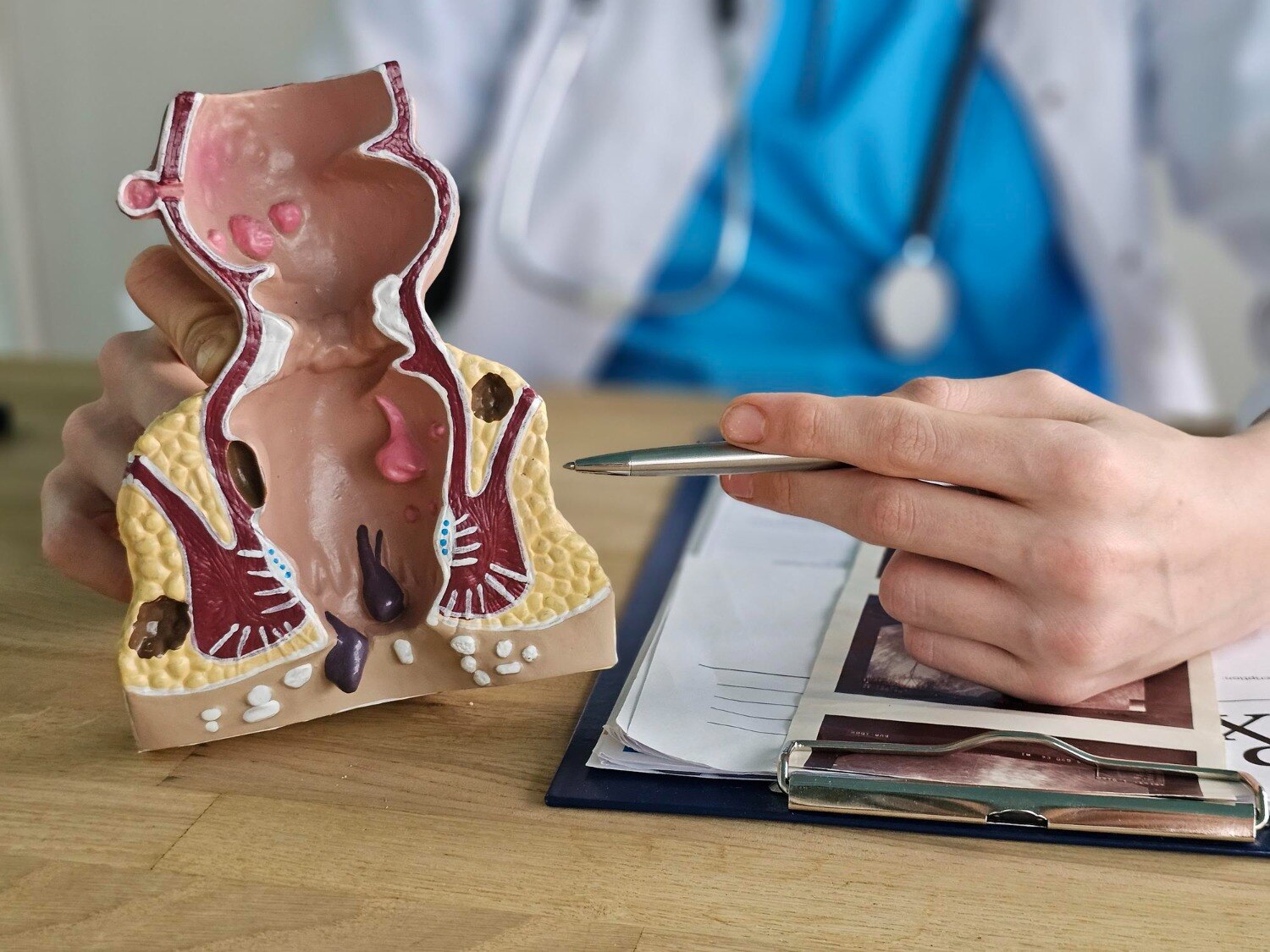
A painful lump beside the anus is not automatically part of an anal fissure. By the end, you will know which symptoms need same-day assessment, what an examination involves, when imaging or anaesthesia is considered, and how to choose a service equipped to manage an abscess as well as a fissure.
Key takeaways
- Seek urgent assessment for fever, swelling, pus or worsening constant anal pain.
- Tell the doctor when pain starts and whether bowel movements trigger it.
- Deep or severe abscesses may require anaesthesia, ultrasound, MRI or examination under anaesthesia.
- Drainage treats pus; antibiotics alone do not replace drainage for most abscesses.
When fissure pain could signal a separate abscess
A fissure is a tear in the anal lining; an abscess is an infected pocket of pus. They can coexist, so seeing or treating a fissure does not rule out a deeper infection.
Fissure pain usually peaks during or after a bowel movement, while abscess pain becomes constant, throbbing, and worse when you sit or move.
Seek same-day assessment if you have:
- A tender lump or increasing swelling beside the anus
- Red, warm, rapidly worsening skin
- Pus, foul-smelling discharge, or a new boil
- Fever, chills, weakness, or feeling generally unwell
- Pain that prevents sitting, walking, or sleeping
- Constant pain that no longer relates mainly to bowel movements
For perianal abscess assessment with anal fissures in Bangalore, expect inspection of the surrounding skin and a gentle rectal examination when pain allows. Severe pain can make an office examination unreliable and require examination under anaesthesia to locate a deeper abscess or an internal fistula opening.
Do not keep intensifying fissure creams or laxatives while a painful lump grows.
After the acute pain settles, recurrent discharge, a boil returning in the same place, or a small external opening suggests a fistula and needs review. An off-midline or multiple fissures, repeated abscesses, or fistulas also warrant evaluation for conditions such as Crohn disease rather than repeated treatment as a simple fissure.
What the doctor asks and checks during assessment
Pain that becomes constant, throbbing, or worse when you sit points away from a fissure alone. A fissure usually causes sharp pain during or after a bowel movement, while a perianal abscess causes persistent tenderness, swelling, warmth, redness, or pus. Both conditions can exist together.
A fissure doctor will ask:
- When the pain began, whether it is worsening, and whether bowel movements trigger it
- Whether you have bright-red bleeding, pus, discharge, fever, chills, or difficulty sitting
- Whether you have had an abscess, fistula, recurrent boil, or previous anal operation
- Whether you have diabetes, immune suppression, inflammatory bowel disease, or other infections
- Which medicines you take, including steroids, immune-suppressing drugs, blood thinners, and antibiotics
Inspection looks for a tender lump, redness, warmth, skin swelling, drainage, or a small external opening. A recurrent opening or discharge after the acute pain settles raises concern for a fistula rather than an indefinitely recurring fissure.
The doctor may perform a gentle digital rectal examination when you can tolerate it, checking tenderness, a deeper mass, and anal muscle spasm. Anoscopy can show the fissure or an internal opening, but severe pain can make office findings unreliable. If the examination cannot safely define the problem, examination under anaesthesia may be needed.
When examination needs anaesthesia or imaging
A clinical examination is enough when inspection shows a superficial, tender swelling and the findings explain the pain. The clinician checks the skin, gently performs a digital rectal examination when you can tolerate it, and may use an anoscope. Do not force an examination through severe pain; it can miss a deeper collection.
Use local anaesthetic when numbing the area will make a focused examination or drainage tolerable. Sedation can help when pain or anxiety prevents a reliable office examination, but extensive disease may require examination under anaesthesia.
During this procedure, the surgeon can locate a deep abscess, horseshoe extension, or internal fistula opening without your muscles tightening from pain.
Imaging is considered when the examination does not explain the symptoms or the infection may lie beyond the skin:
- MRI of the pelvis: preferred for mapping deep collections and fistula tracts.
- Endoanal ultrasound: useful for selected anal-wall or sphincter findings.
- CT: useful when rapid assessment is needed or abdominal disease is also suspected.
Scans are not routine for an obvious superficial abscess, and waiting for unnecessary imaging can delay drainage. Imaging becomes more important with a deep, recurrent, occult, horseshoe-shaped abscess, Crohn disease, or persistent discharge after earlier drainage. These are key points in abscess evaluation in Bangalore and elsewhere.
Drainage, antibiotics and follow-up for fistula or fissure
Once an abscess is confirmed, drainage is the key treatment: a clinician opens the collection so pus can escape, usually through a small incision. Antibiotics do not reliably cure a closed abscess and should not delay drainage.
They are added when there is spreading skin infection, fever or other systemic illness, immune suppression, diabetes, or another risk identified by the clinician.
After drainage, follow the wound-care instructions and attend the review arranged for you. Seek urgent reassessment if pain or swelling increases, fever develops, pus continues to build, or the wound does not improve.
A deep, recurrent or unexplained abscess may need imaging or examination under anaesthesia to find a hidden cavity, horseshoe abscess or internal opening.
Arrange fistula assessment if you develop persistent or recurrent discharge, a boil in the same location, or a small external opening after the acute pain settles. The clinician may inspect the skin, perform a gentle rectal examination, use anoscopy, or request MRI when the tract is deep or complex.
An abscess can form a fistula after drainage.
Drainage alone does not treat the underlying fissure. Once infection is controlled, fissure care may include fibre, stool-softening treatment, sufficient fluids, warm baths and topical glyceryl trinitrate or a topical calcium-channel blocker. Persistent symptoms can lead to botulinum toxin or surgery; discuss baseline continence and any previous sphincter injury before sphincter surgery.
Choosing an anorectal service in Bangalore
Before choosing an anal fissure clinic in Bangalore, verify that it can assess a painful lump as a possible abscess rather than treating every symptom as fissure pain. Ask who performs the examination: a colorectal surgeon or another clinician experienced in anorectal disease.
Check these practical points by phone:
- Can you receive same-day assessment for increasing constant pain, swelling, fever or pus?
- Can the service perform urgent abscess drainage, or arrange transfer to a hospital?
- Is examination under anaesthesia available when severe pain makes an office examination unreliable?
- Can the clinician assess a recurrent abscess, horseshoe abscess or fistula?
- Who provides follow-up if discharge, a recurrent boil or an external opening remains after drainage?
- Will the doctor decide on imaging from the examination, rather than ordering routine scans for everyone?
A service offering only fissure medicines is not enough for a deep, recurrent or unexplained abscess. Bharath Piles And Fistula Clinic is one option to question specifically about its access to specialist anorectal examination, drainage, anaesthesia and fistula follow-up before you attend.
| Service feature | What to verify | Why it matters |
|---|---|---|
| Specialist examination | Who examines you and what they assess | A fissure can coexist with a separate abscess |
| Urgent treatment | Same-day drainage or hospital referral | Delayed drainage can prolong infection |
| Imaging pathway | When MRI or another scan is ordered | Deep or recurrent disease can be missed without imaging |
| Follow-up | Review for fistula or persistent fissure | An abscess can leave a continuing tunnel to the skin |
Frequently asked questions
How can you tell whether fissure pain could indicate a perianal abscess?
Fissure pain usually follows bowel movements and feels sharp or burning. Constant throbbing pain, a tender swelling, pus, fever or worsening redness suggests a separate abscess and needs prompt assessment.
What happens during a perianal abscess assessment?
The doctor asks about pain, bowel movements, fever, discharge and previous anorectal problems, then inspects the skin and checks for swelling, tenderness, drainage and a possible fistula.
When are anaesthesia or imaging needed for abscess evaluation?
Examination under anaesthesia helps when pain prevents an adequate examination or when the abscess is deep. Ultrasound or MRI can help locate an abscess or fistula that is not visible externally.
Are antibiotics enough to treat a perianal abscess?
Drainage is the main treatment for a pocket of pus. A doctor adds antibiotics when infection has spread, fever or significant illness is present, or conditions such as diabetes increase risk; follow-up checks healing and fistula formation.
Keywords